Boost on a Budget? Why Forced Induction Always Costs More Than the Kit
Let's be real. The moment you start researching forced induction, your brain does this thing where it locks onto the horsepower number and conveniently ignores everything else. A turbo kit for your platform shows up online for $1,500. Your buddy says he made 400 wheel horsepower on his. You're already measuring underhood clearance in your head.
Then reality shows up — usually around month three of the build — and it brings receipts.
Forced induction is one of the most rewarding paths to serious street performance. But it's also one of the most misunderstood from a cost perspective. What looks like a bolt-on upgrade on paper is actually the front door to a much bigger house. And that house has a lot of rooms that all need furnishing.
The Kit Is Just the Entry Fee
Whether you're going turbo or supercharger, the hardware itself — the compressor, manifold, intercooler, piping, and wastegate — is only a fraction of the total investment. Builders who've been through it consistently say the kit accounts for somewhere between 30 and 50 percent of what they actually spent by the time the car was making reliable power on the street.
Jordan M., a Mustang GT owner out of Phoenix who built a twin-screw supercharger setup on his 5.0, put it plainly: "I budgeted $4,500 for the whole thing. I spent $11,200 before I stopped counting. And I did a lot of the labor myself."
That gap between expectation and reality is where most first-time boost builders get humbled.
Premium Fuel Is Now a Lifestyle
Once you're running boost, your relationship with the gas station changes permanently. Most street turbo and supercharger setups — especially anything pushing past stock power levels — demand 91 or 93 octane minimum. In parts of the country where premium fuel is scarce or significantly more expensive, that adds up fast.
If you're commuting in a boosted daily driver, expect your fuel costs to jump 20 to 40 percent depending on your tune and driving habits. Over the course of a year, that's real money. Over the life of the build, it's a line item that never goes away.
Some builders run flex fuel setups with E85 to offset this, but that's another rabbit hole with its own costs — injector upgrades, fuel pump swaps, and a flex fuel sensor kit, plus a retune.
Your Cooling System Was Not Built for This
The factory cooling system on most street cars is engineered for stock output. Add a supercharger or turbo, and you're generating substantially more heat — both in the engine bay and in the intake charge itself.
Intercooler upgrades, larger radiators, upgraded coolant lines, and sometimes auxiliary oil coolers become necessary pretty quickly, especially if you're pushing past a modest power bump. Water-methanol injection is another option some builders use to manage intake temps, but again — more parts, more tuning, more cost.
Skip the cooling upgrades and you're not just leaving performance on the table. You're actively shortening the life of your engine. Heat is the enemy of reliability, and boost makes a lot of it.
The Internals Question Nobody Wants to Answer
Here's where builds get expensive in a hurry. Most factory engines are built to handle factory power. The pistons, connecting rods, and head gaskets are engineered with specific tolerances in mind. Push cylinder pressure high enough and those tolerances become liabilities.
For modest power goals — say, 50 to 100 horsepower over stock — most modern engines will hold together on a conservative tune with quality fuel. But once you start chasing serious numbers, the conversation shifts to forged internals, upgraded head studs, and thicker head gaskets.
A set of forged pistons and rods for a popular platform like the EcoBoost Mustang or a turbocharged WRX can run anywhere from $1,500 to $4,000 in parts alone, not counting machine shop labor. If you're building a high-compression LS for boost, that number climbs higher.
The frustrating part? A lot of builders skip this step, run the car for a season, and then do the engine work anyway — after something breaks. Doing it twice always costs more than doing it right the first time.
Tuning Is Non-Negotiable, and It Isn't Cheap
A forced induction setup without a proper tune is a liability. The factory ECU is calibrated for naturally aspirated operation. Add boost without addressing fueling, ignition timing, and boost pressure control, and you're gambling with your engine every time you get into the throttle.
A quality dyno tune from a reputable shop runs $400 to $900 for most platforms, sometimes more for complex setups or flex fuel calibrations. If you're running a standalone ECU, you can add another $800 to $2,000 for the unit itself before the tuner even looks at your car.
And here's the thing — tuning isn't always one and done. If you change something (different exhaust, new injectors, altitude change, fuel blend), you're often back on the dyno. Those sessions add up.
Supporting Mods: The List That Never Ends
Beyond the big-ticket items, forced induction builds have a long tail of supporting modifications that quietly drain the budget. Upgraded fuel injectors. A higher-flow fuel pump. Reinforced motor mounts to handle the added torque. Stronger axles if you're running front-wheel drive. A bigger throttle body. An upgraded blow-off valve. Better spark plugs rated for boost.
None of these are outrageously expensive on their own. But they stack. And each one often requires some labor time, whether you're paying a shop or investing your own weekend hours.
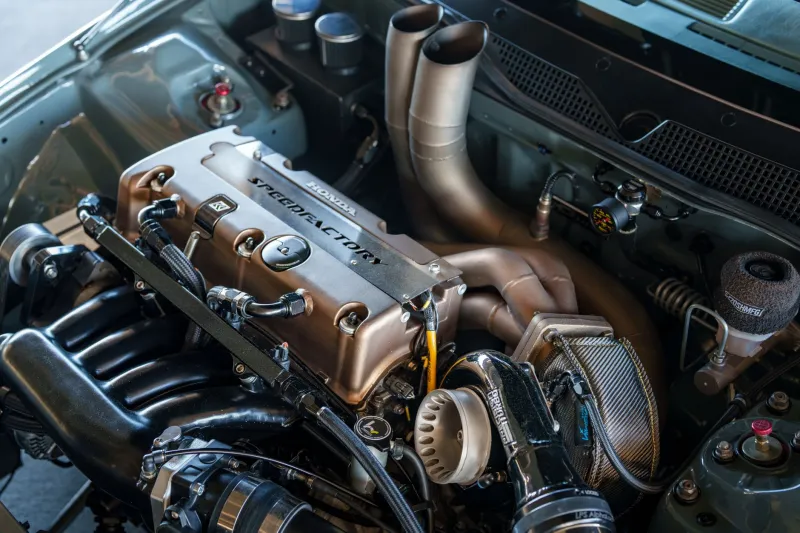
Dave R., a Honda builder in Chicago who runs a turbocharged K-series setup in his Civic, described it this way: "Every time I thought I was done, something else came up. I wasn't making bad decisions — each part made sense. But I didn't budget for the whole system. I budgeted for the kit."
So Is Forced Induction Worth It?
Absolutely — with the right expectations going in. Boost is still one of the most efficient ways to make significant power gains relative to displacement. A well-executed turbo or supercharger build can transform a car in ways that naturally aspirated modifications simply can't match at the same price point.
But the operative phrase is well-executed. That means budgeting honestly from the start. It means accounting for fuel costs, cooling, internals, tuning, and supporting mods before you pull the trigger on a kit. It means being realistic about your power goals and what those goals actually require to achieve reliably.
The builders who come out of forced induction projects happy are the ones who treated it like a system, not a single purchase. The ones who come out frustrated — and sometimes with a damaged engine — are the ones who chased the horsepower number without following it all the way to the end.
Boost is worth it. Just make sure you're budgeting for all of it.