Junkyard Gold: How Smart Street Builders Are Unlocking Insane Power for Pennies on the Dollar
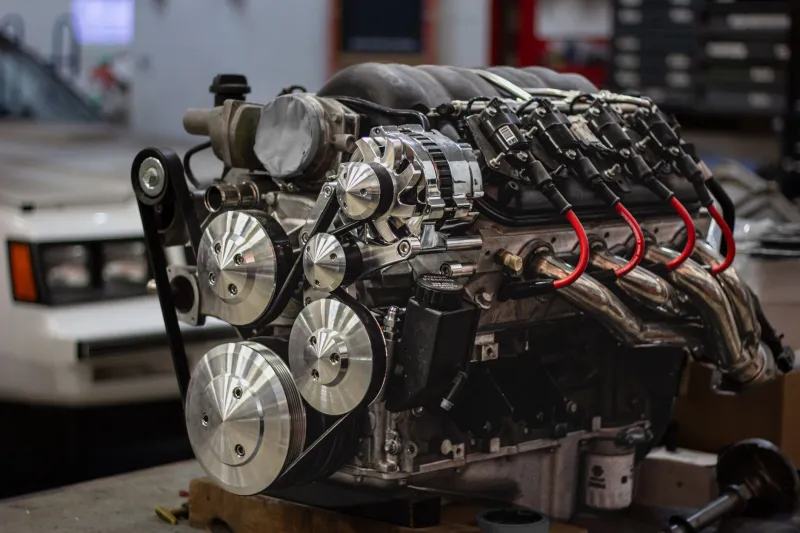
There's a moment every serious builder hits — usually right after dropping another $800 on an intake, a tune, and a set of headers — where the math stops adding up. You've spent three grand in bolt-ons and picked up maybe 40 horsepower. Your buddy, meanwhile, yanked a K-series out of a wrecked Civic Si for $600, dropped it into his hatch, and is now making twice your power on a fraction of your budget. That moment? That's the engine swap awakening.
Engine swaps have been part of American car culture since hot rodders were pulling flatheads out of Model As and stuffing in whatever made more noise. But something has shifted in the last decade. Donor cars are more plentiful, fabrication knowledge is more accessible, and the internet has democratized the kind of build information that used to live only in the heads of old-school shop guys. The result is a new generation of street builders treating swaps not as a last resort, but as the first move.
Why Bolt-Ons Hit a Wall
Let's be real about what bolt-ons actually do. An intake, exhaust, and tune on a naturally aspirated four-cylinder might net you 15–25 horsepower on a good day. Add headers and a cam, and maybe you're pushing 40–50 over stock. That's not nothing, but on a car that started at 150 horses, you're still in the same zip code performance-wise. You've also spent anywhere from $2,000 to $5,000 to get there, and every subsequent mod costs more for less return.
Swaps flip that equation entirely. Instead of chasing diminishing returns on a platform with a ceiling, you're installing a completely different ceiling. Or tearing the roof off altogether.
The Platforms Worth Knowing
Not every swap is created equal, and the smart money goes where the ecosystem is deep. Here are the three platforms dominating street build culture right now.
Honda K-Series (K20/K24)
If you're in the import world, the K-series is the answer to almost every question. These engines — pulled primarily from 2002–2011 Civic Si, RSX Type-S, and Accord Sport models — are everywhere in junkyards and on Craigslist. A low-mileage K20A2 can be had for $400–$700 all day long. The platform has decades of aftermarket support, and a built K24 with a K20 head (the so-called K24/K20 hybrid, or "frankenstein" build) can push 300+ wheel horsepower on a reasonable budget. Throw boost at it, and 400whp becomes very achievable.
The swap fits naturally into most EG, EK, and DC chassis with the right mounts — which run $150–$300 from established vendors like Hasport or Innovative. This is a swap with a roadmap, and that matters enormously when you're working with limited time and money.
Toyota 2JZ-GTE
The 2JZ is basically mythology at this point, but it's mythology built on real engineering. Toyota's twin-turbo inline-six from the 1993–2002 Supra Turbo is famous for one reason: the bottom end can handle absurd power levels with minimal internal modification. Stock internals regularly support 600–700 horsepower with supporting mods. That's not a typo.
The catch is the donor cost. A complete 2JZ-GTE swap from a Supra has gotten expensive as the Supra market went collector. But the 2JZ-GE (non-turbo version from Lexus IS300s and GS300s) can be found for $500–$1,200, and with a turbo kit, it becomes a different animal. The swap shows up in everything from S-chassis Nissans to E36 BMWs, and the fabrication community around it is enormous.
GM 5.3L LM7/LY5 (LS-Adjacent)
Everyone knows about the LS swap. What fewer people talk about is the 5.3L iron-block variant pulled from half-ton trucks and SUVs — the LM7, LY5, and L59 engines that came in everything from Silverados to Tahoes between 1999 and 2007. These aren't the glamorous aluminum LS2s or LS3s. They're heavy, they're common, and they're cheap. We're talking $300–$600 for a complete pull from a wrecked truck.
With a cam swap, intake, and tune, a junkyard 5.3 can make 380–420 horsepower at the crank — reliably, repeatably, and on pump gas. Drop one into a first-gen Camaro, a Fox Body, or an S10, and you've got a street weapon that cost less than most people spend on wheels.
Real Builds, Real Numbers
Talk is cheap, so let's look at actual projects.
Tyler M., a builder out of Phoenix, swapped a K24/K20 setup into his 2000 Civic hatchback. Total engine cost: $650 for a low-mileage K24A2 and $350 for a K20 head from a parts car. Add $280 in swap mounts, $400 in miscellaneous lines, sensors, and hardware, and $600 for a base tune. His before number on the stock D-series? 98 wheel horsepower. After the K swap with no other modifications: 187whp. He's since added a basic turbo kit and is sitting at 310whp. Total project cost including the turbo setup: just under $4,200. A comparable power level through bolt-ons on the original motor would have been impossible.
Marcus D. in Atlanta pulled a 5.3 LM7 out of a wrecked 2003 Tahoe for $400 and dropped it into his 1979 El Camino. With a truck cam, ported intake, and a Holley EFI system, he's making 395 horsepower at the wheels. The whole swap, including all fabrication and wiring, came in at $3,800. His previous small block 350 made 220hp after years of bolt-on work and a carb upgrade.
What Swaps Actually Cost (Honestly)
Here's where a lot of first-timers get burned: the engine is often the cheapest part. Budget realistically across these categories:
- Donor engine: $300–$1,500 depending on platform
- Swap mounts and crossmember: $150–$600
- Wiring and ECU adaptation: $200–$800 (more if you're paying a shop)
- Cooling, fuel system upgrades: $300–$700
- Transmission and driveline: $400–$1,200
- Fabrication labor (if not DIY): $800–$2,500
- Tune: $400–$800
A realistic all-in budget for a well-executed swap lands between $3,000 and $7,000. That sounds like money — and it is — but compare it to what you'd spend trying to extract the same power through conventional mods on a stock platform. The math usually favors the swap, especially once you factor in the headroom for future upgrades.
The Culture Shift
What's changed isn't just the economics. It's the attitude. A new generation of builders has grown up watching swap content on YouTube, joining platform-specific forums, and learning fabrication skills that used to take years in a shop to acquire. The barrier to entry on a competent swap has never been lower.
That doesn't mean it's easy. Swaps demand patience, research, and a tolerance for setbacks. But for builders who are serious about power — not just the appearance of power — the junkyard is the most honest parts store in the game. And right now, it's stocked better than ever.
The $500 engine sitting in a wrecked donor car two miles from your house might be the best performance investment you haven't made yet.